Page 1 of 1
Best way to notate natural harmonic gliss
Posted: 15 Sep 2026, 15:59
by KlausWH
Let's say you wanted to notate a natural harmonic gliss going from the bottom of the string, to an indefinite high point on the string, and then back down again.
What would be the best way to notate this, without writing an exact note for the highest point?
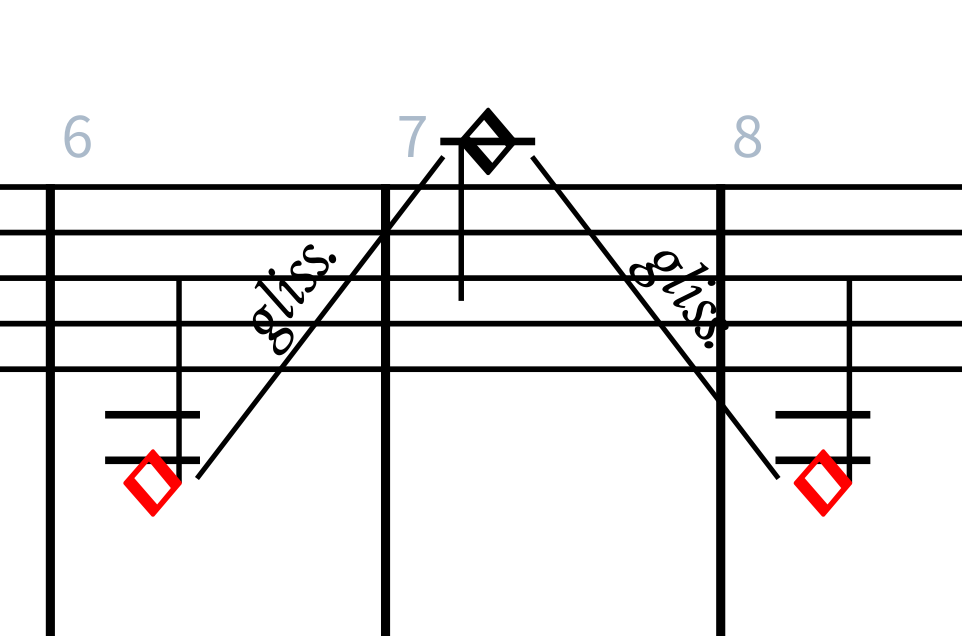
- Gliss.png (55.51 KiB) Viewed 156 times
Bad example just to roughly show what I mean
Re: Best way to notate natural harmonic gliss
Posted: 15 Sep 2026, 16:49
by John Ruggero
The standard symbol for the highest possible note on an instrument is a triangle-shaped note head pointing upward.
Re: Best way to notate natural harmonic gliss
Posted: 15 Sep 2026, 18:48
by OCTO
You cannot play harmonics on the open string, therefore I would suggest writing the first note from which you want to start the harmonics. That would be an A or A♭. You could perhaps put it in parentheses.
And as John said, it is the upward-pointing triangle that represents the “highest” pitch. However, you need to specify this, since it is not the most common convention among string players.
Furthermore, when playing from the bottom end towards the top end of a string, you don’t actually get the harmonics sounding progressively upwards. From the bottom end to the middle, the sounding pitch goes DOWNWARDS, and from the middle onwards it goes upwards, and vice versa! So, in your notation, the actual sounding result is: twice down-up.
Re: Best way to notate natural harmonic gliss
Posted: 15 Sep 2026, 19:31
by David Ward
FWIW here is a brief, twice played harmonic glissando, as I notated it back in 1978 (heavens: nearly 50 years ago!). It's from my first cello concerto. I suspect this may not be what you want, but in case it's of any passing interest… (I see the direction arco is missing after the pizz. It must have been correct in the part, but even so…)
Re: Best way to notate natural harmonic gliss
Posted: 15 Sep 2026, 20:31
by OCTO
David: beautiful!!
Re: Best way to notate natural harmonic gliss
Posted: 16 Sep 2026, 10:41
by KlausWH
OCTO wrote: 15 Sep 2026, 18:48
You cannot play harmonics on the open string, therefore I would suggest writing the first note from which you want to start the harmonics. That would be an A or A♭. You could perhaps put it in parentheses.
And as John said, it is the upward-pointing triangle that represents the “highest” pitch. However, you need to specify this, since it is not the most common convention among string players.
Furthermore, when playing from the bottom end towards the top end of a string, you don’t actually get the harmonics sounding progressively upwards. From the bottom end to the middle, the sounding pitch goes DOWNWARDS, and from the middle onwards it goes upwards, and vice versa! So, in your notation, the actual sounding result is: twice down-up.
And if you didn't care too much about the pitch, and just wanted to show the motion of the fingers, a more prescriptivist approach, how would you go about notating that?
Re: Best way to notate natural harmonic gliss
Posted: 16 Sep 2026, 12:49
by OCTO
Instead of pitch G use pitch A (first finger), then use triangle notehead for the highest tone.
And use harmonics─────────┐ above the phrase.
Remember, your first note is making glissando, your last note is not making glissando. It is the final note of two beats sounding still.